

Blog
How to Collect Money for Stag Do: A Complete Guide
Indice dei contenuti
- How to Collect Money for Stag Do: Setting Your Budget
- Best Stag Do Payment Apps and Platforms
- Collecting Deposits and Managing Group Payments
- How to Chase Stag Do Money Without Awkwardness
- Stag Do Budget Template and Financial Transparency
- How to Handle Stag Do Dropouts and Late Payments
- Alternative Fundraising Methods for Group Expenses
- Security, Fraud Prevention, and Legal Considerations
Last Updated: July 3, 2026
Quick answer
How to Collect Money for Stag Do: A Complete Guide in short: activities from 35€ per person, groups from 8 people, and a full weekend planned for you with one contact, one itinerary and one invoice. Send your dates and group size and we come back with availability and a group price.
Collecting money for a stag do can feel awkward, especially when managing friends with different financial situations. Coordinating payments from multiple attendees is one of the biggest headaches of party planning. At Idee per l'addio al celibato, we’ve helped organize hundreds of stag parties and learned that the right payment system makes the difference between smooth logistics and constant follow-ups. This guide covers everything from setting your budget to chasing unpaid balances, with practical tools you can use immediately.
How to Collect Money for Stag Do: Setting Your Budget
Before collecting a single pound, know what you’re collecting for. A clear budget prevents arguments and gives attendees a concrete number to commit to.
Calculate Total Costs
List every expense: accommodation, activities, meals, transport, drinks, and contingency funds. Be generous with estimates, stag dos almost always cost more than anticipated. Divide the total by confirmed attendees to get the per-person contribution. Underestimating costs backfires when you need additional money mid-trip. It’s better to quote high and return surplus funds.
Add a 10-15% buffer to your total budget for unexpected costs, last-minute activities, or tips. This prevents awkward requests for additional money during the event itself.
Set Per-Person Contribution
Decide on the contribution structure. The most common approach is a flat fee per person, though you can split costs unevenly if some attendees stay longer or participate in premium activities. If the groom is paying for certain elements, adjust the group contribution accordingly and make this clear upfront.
Document the breakdown in writing: "Accommodation: £80, activities: £45, meals: £60, contingency: £15 = £200 per person." This transparency prevents confusion and builds trust.
Best Stag Do Payment Apps and Platforms
Digital payment tools have revolutionized group expense management. They eliminate cash handling, provide real-time tracking, and create an automatic record of who’s paid what.
Digital Payment Solutions
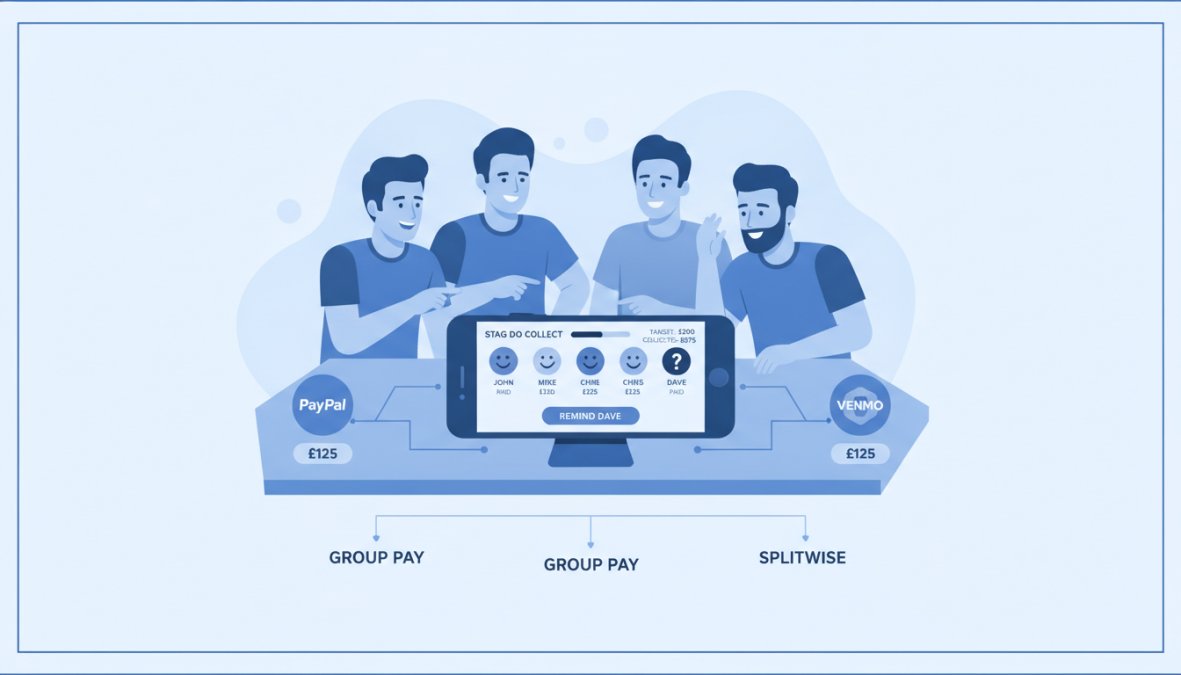
Splitwise is the most popular choice for stag dos because it tracks shared expenses and automatically calculates who owes what. You can create a group, add expenses as they happen, and generate a final settlement showing exactly how much each person needs to pay.
Monzo e Revolut are banking apps that let you create shared spending pots. Everyone can contribute to a single pot, and the money sits there until needed. Both apps send real-time notifications when money is added.
Leetchi e Collectiv are purpose-built for group fundraising. You set a target amount, create a payment link, and share it with attendees. These platforms are particularly useful if collecting from people who aren’t on traditional banking apps.
PayPal remains reliable for collecting larger amounts. You can request money from multiple people at once, though PayPal takes a small percentage of each transaction.
| App | Best For | Pros | Cons |
|---|---|---|---|
| Splitwise | Tracking shared expenses | Free, automatic calculations, detailed history | Requires manual entry of each expense |
| Monzo/Revolut | Simple pot contributions | Real-time notifications, everyone can add | Requires everyone to have the app |
| Leetchi/Collectiv | Fundraising from non-banking friends | Payment link sharing, no app required | Takes small commission on transactions |
| PayPal | Large lump-sum collection | Widely used, secure | Transaction fees, less granular tracking |
The best choice depends on your group’s tech comfort level. If everyone uses banking apps regularly, Monzo or Revolut is fastest. If collecting from less tech-savvy people, a simple payment link from Leetchi works better.
The single biggest advantage of digital payment apps is that they create an automatic record. When someone disputes whether they’ve paid, you have proof.
Collecting Deposits and Managing Group Payments
Most stag dos require deposits upfront to secure accommodation and activities. This protects you from last-minute cancellations.
Initial Deposit Strategy
Set a deposit deadline 6-8 weeks before the event. A typical deposit is 30-50% of the total per-person cost. Be clear about the deadline in writing with the exact date and amount due, including the payment method.
Many groups require deposits to be non-refundable after a certain point. A reasonable policy is: deposits are fully refundable up to 8 weeks before the event, 50% refundable from 8-4 weeks out, and non-refundable within 4 weeks.
Payment Tracking and Real-Time Updates
Use a simple spreadsheet or payment app dashboard to track who’s paid. Share this with the group monthly so people know the status. Create a tracker with columns: name, deposit due date, deposit amount, final payment due date, final amount, and paid status. Update it weekly and send a summary message: "10 out of 12 deposits received. Final payment deadline is June 1st."
Real-time updates help you spot problems early. If someone hasn’t paid by the deposit deadline, you can follow up while there’s still time to find a replacement attendee if needed.
How to Chase Stag Do Money Without Awkwardness
The money conversation is never comfortable, but it’s essential. Treat it like business, not friendship drama.
Setting Clear Payment Deadlines
Communicate deadlines in multiple formats: text, email, and group chat. A week before the deadline, send a reminder. Three days before, send a final reminder. On the deadline day itself, send one more message thanking those who’ve paid and gently noting who hasn’t.
If someone misses the deadline, reach out privately with a friendly tone: "Hey mate, just checking in on the deposit. Did you have any issues with the payment link, or do you need a different payment method?"
Never call someone out publicly in the group chat for not paying. Always follow up privately first.
Friendly Reminder Strategies
Space out follow-ups: initial reminder 1 week before deadline, second reminder 3 days before, third reminder on deadline day, and final follow-up 3-5 days after if still unpaid.
When someone hasn’t paid after the deadline, ask directly but kindly: "I need to finalize the accommodation booking by Friday. Can you let me know if you’re still able to make the deposit, or if there’s an issue I can help with?"
If someone has genuine financial problems, discuss options: can they pay half now and half later? Can they skip certain activities? Show flexibility where you can, but protect yourself by getting something in writing.
Stag Do Budget Template and Financial Transparency
Creating a shared budget document keeps everyone on the same page and prevents disputes about where money is going.
Creating Your Budget Framework
Use a simple spreadsheet with these sections:
- Fixed Costs: Accommodation, transport, activity bookings
- Variable Costs: Food, drinks, tips (estimated)
- Contingency: 10-15% buffer for unexpected expenses
- Per-Person Breakdown: Total divided by confirmed attendees
Update this document as you make bookings. Share it with the group every 2-3 weeks. A simple message: "Updated budget attached. We’ve locked in accommodation (£600) and activities (£180). Current per-person cost is £195."
Sharing Expense Breakdowns
Create a final expense breakdown before the trip showing exactly where every pound went. If you’ve collected £200 per person and spent £193.33, you have a surplus. Decide upfront how to handle this: refund the difference, donate it to charity, or use it for a final group meal. Document this decision and follow through.
How to Handle Stag Do Dropouts and Late Payments
Not everyone who commits will actually attend. You need a plan for dropouts.
Planning for Short-Notice Cancellations
Build dropout scenarios into your initial budget. Assume a 10% dropout rate. For deposits, set a clear refund policy: full refund if cancelled 8+ weeks before the event, 50% refund from 8-4 weeks out, no refund within 4 weeks. This incentivizes early cancellations.
When someone drops out, immediately contact potential replacements with details and cost breakdown.
Adjusting the Budget Mid-Planning
If multiple people drop out, discuss it with the group rather than deciding unilaterally. Send a message: "We’ve had 2 cancellations, which brings us from 12 to 10 attendees. This increases per-person cost from £200 to £215. I can either ask for the additional £15 from everyone, or we can cut one activity to keep costs at £200. What works better for the group?"
Always collect deposits before booking non-refundable accommodation or activities. This protects you from paying for space that attendees don’t use.
Alternative Fundraising Methods for Group Expenses
Creative fundraising can supplement the group fund or reduce per-person costs.
Stag and Doe Events and Ticket Sales
A stag and doe is a fundraising party where tickets are sold to the general public. Charge £20-30 per ticket and aim for 50-100 attendees. A simple formula: 75 tickets at £25 = £1,875, which significantly reduces per-person costs.
Organize games, raffles, or auctions. Sell raffle tickets for £1-5 each with prizes donated by local businesses. A raffle alone can raise £200-400.
Silent Auctions and Entrance Fees
Host a silent auction where people bid on donated items or experiences. Ask local businesses for donations: restaurants might donate gift certificates, pubs might donate bottles of spirits. A well-organized silent auction with 20-30 items can raise £500-1,000.
Alternatively, charge an entrance fee for the stag do itself. If renting a venue or bar for the night before traveling, charge attendees £15-20 to enter.
Security, Fraud Prevention, and Legal Considerations
Handling group money comes with responsibilities. Protect yourself and your attendees by following basic security practices.
Protecting Payment Information
Use established payment platforms rather than collecting bank details via email or text. Apps like Monzo, Revolut, and Splitwise encrypt payment information.
If someone insists on paying by bank transfer, use a standard business account rather than a personal account if possible. Never share payment information in group chats. Keep payment links and account details in private messages.
If collecting cash, keep it in a separate envelope and document every transaction.
Tax and Legal Implications of Large Fundraising
For small stag dos with 8-12 people, collecting money and spending it on the group activity is straightforward. However, if organizing a large event with significant fundraising (over £1,000 from sources outside the core group), tax implications may apply.
In the UK, if raising money for a charitable cause, you may need to register as a fundraiser. For personal stag dos, money collected from attendees is simply shared expenses, not taxable income.
Keep all group funds in a separate account, document every transaction, and return any surplus to attendees or donate it to a cause the group agrees on.
Keep receipts and payment records for everything. Digital payment apps provide this automatically, but if handling cash or bank transfers, create a simple spreadsheet showing date, amount, payer, and purpose.
Managing money for a stag do doesn’t have to be stressful if you use the right systems. Whether collecting deposits through a payment app, tracking expenses in a shared spreadsheet, or organizing a fundraiser, the key is transparency and clear communication. Start with a clear budget, choose a payment platform that fits your group’s tech comfort level, and communicate deadlines consistently. When everyone knows exactly what they’re paying and where the money is going, you’ll spend less time chasing payments and more time planning an incredible stag do experience.
Domande frequenti
What is the best way to collect money for a stag do?
The best approach combines a clear budget, transparent communication, and reliable payment tools. Start by calculating all costs (accommodation, activities, food, transport) and divide by attendees. Use dedicated payment apps like Splitwise, Revolut, or Monzo for real-time tracking. Set a specific deposit deadline (typically 4-6 weeks before the event) and use a payment link or QR code for easy collection. Regular updates and financial transparency build trust and reduce friction.
Should I use a stag do payment app or collect cash?
Payment apps are generally superior for group expenses. Apps like Leetchi, Collctiv, and Splitwise automate tracking, send reminders, and provide real-time updates to all attendees. They eliminate cash handling errors and create a clear audit trail. However, some attendees may prefer cash, offer both options but encourage app usage. Apps work especially well for international trips where currency conversion is needed, reducing exchange rate issues.
How do you handle people who don't pay for a stag do?
Set clear deadlines upfront and implement a tiered reminder system. Send friendly reminders at the 2-week and 1-week marks. If payment is still outstanding one week before the event, have a direct conversation with the person, they may face exclusion or reduced participation. For short-notice cancellations, clarify your refund policy beforehand. Consider requiring a non-refundable deposit to reduce no-shows. Document all communications and payment status for transparency.
When should you start collecting money for a stag do?
Begin collecting deposits 6-8 weeks before the event. Request an initial deposit (typically 25-50% of the total cost) to secure bookings and gauge commitment. Collect the balance 2-3 weeks before departure. This timeline gives attendees notice, allows you to finalize vendor bookings, and provides time to handle dropouts or payment issues. For international trips or large group expenses, start even earlier to manage currency conversion and secure better rates.
This article was written using GrandRanker
